News

Communication to data subjects regarding the ICT incident
Dear Users,
Sabiana S.p.A. has experienced an unauthorized access to its website.
The incident has been successfully contained: the website is currently active and fully operational.
Further investigations are ongoing with the support of the supplier in order to determine with certainty the scope of the incident, the number of data subjects involved, and the categories of personal data affected.
At this stage, we can already inform you that some personal data have been compromised in terms of confidentiality and are partially unavailable.
Sabiana S.p.A. sincerely apologizes for any inconvenience this may have caused.
The potential consequences of the breach may include, for example, misuse of contact data, phishing attempts, or unwanted communications.
We therefore recommend that you:
Sabiana S.p.A. is taking all actions considered appropriate at this stage to further protect its IT assets and, consequently, the personal data stored therein.
The measures adopted include, for example, resetting all passwords, restoring the database from backup, and implementing firewall interventions.
Should you have any questions or require further clarification, please write to privacy@sabiana.it and/or dpo.sabiana@dpoprofessionalservice.it.
Kind regards,
Sabiana S.p.A.
do not respond to suspicious requests or messages, especially those relating to payments, such as requests to change payment details or disclose passwords or bank account information;do not open any links unless you are absolutely certain that they come from a reliable source.Update as of 08-05-2026: the analyses have been completed and the scope, number, and categories of personal data involved have been defined, along with the appropriate notifications to the competent Authorities.
Incentives for upgrading hotels?
Upgrading hotel facilities and constructing new hospitality facilities should be subsidised with an incentive policy to operate like the ecobonus. The announcement was made by Minister Dario Franceschini during a recent audition in the Industry Commissions of the Lower and Upper Chamber.
If the bonuses announced were to become real, this would be a good opportunity for Sabiana, which is able to offer innovative, high energy efficiency conditioning equipment, that assure extremely high standards in indoor air quality thanks to the Crystall filter.
These features would allow hotel owners to upgrade their facilities to the top of their range, while taking advantage from the government’s bonuses.
Final Text
Upgrading hotel facilities and
constructing new hospitality facilities should be subsidised with an incentive
policy to operate like the ecobonus. The announcement was made by Minister
Dario Franceschini during a recent audition in the Industry Commissions of the
Lower and Upper Chamber.
If the bonuses announced were to become real, this would be a good opportunity
for Sabiana, which is able to offer
innovative, high energy efficiency conditioning equipment, that assure
extremely high standards in indoor air quality thanks to the Crystall filter.
These features would allow hotel owners to upgrade their facilities to the top
of their range, while taking advantage from the government’s bonuses.
Final Text
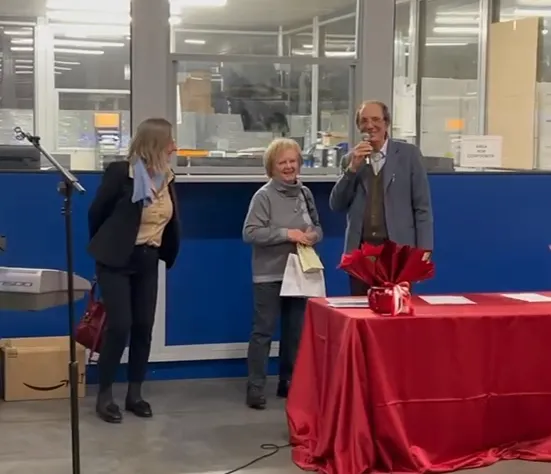
Celebrating 280 Years of Dedication
Today is a special day for Sabiana: we celebrate seven extraordinary individuals who, after a career dedicated with passion and commitment, are now embarking on a new chapter in their lives—their well-earned retirement.Together, they have contributed a total of 280 years of experience, professionalism, and dedication, leaving an indelible mark on our company and community. This milestone represents not only years but also stories, achievements, and shared values that have shaped Sabiana into what it is today.A heartfelt thank you to Maria Pia, Maurizio, Emilio, Marco, Mario, Mauro, and Gianluigi.Each of them has embodied the values of Sabiana, contributing with skills and humanity to create a unique work environment where daily dedication and collaboration have always been central.To all of them, we extend our sincerest gratitude and best wishes for the future. We are proud of the journey we have taken together and confident that this new phase will be filled with joy and serenity.Thank you for everything you have done for Sabiana: your legacy will always be a part of our story.
Good air quality increases performance in the office.
According to Harvard researchers, who published the study on Environmental Health Perspective, people who work in well aerated premises, with low CO2 and indoor pollution levels, achieve better scores in cognitive functions compared to people whose offices are less green, with pollution and CO2 levels considered to be standard.
The researchers focused on the impact of room ventilation, chemicals and CO2 on workers’ cognitive functions by exposing 24 workers to different levels of CO2, ventilation and VOC concentrations, commonly emitted in offices. Participants exposed to premises with the best air quality, achieved on average double scores in cognitive performance compared to those who worked in conventional premises.
The researchers also underline the impact of CO2 levels: the average score drops when the CO2 level increases. “These results point to the fact that even modest improvements in the quality of indoor air might have a deep impact on workers’ decision-making performance,” said Joseph Allen of Harvard University, the main author of the study.
According to Harvard
researchers, who published the study on Environmental Health Perspective,
people who work in well aerated premises, with low CO2 and indoor pollution
levels, achieve better scores in cognitive functions compared to people whose
offices are less green, with pollution and CO2 levels considered to be
standard.
The researchers focused on the impact of room ventilation, chemicals and CO2 on
workers’ cognitive functions by exposing 24 workers to different levels of CO2,
ventilation and VOC concentrations, commonly emitted in offices. Participants
exposed to premises with the best air quality, achieved on average double
scores in cognitive performance compared to those who worked in conventional
premises.
The researchers also underline the impact of CO2 levels: the average score
drops when the CO2 level increases. “These results point to the fact that even
modest improvements in the quality of indoor air might have a deep impact on
workers’ decision-making performance,” said Joseph Allen of Harvard University,
the main author of the study.
This office is a gas chamber...
This was evidenced by the just published, extensive research called OfficAir Project that the prestigious institution has conducted in eight European countries, including Italy. The results are disheartening to say the least: formaldehyde, benzene and terpenes are far above the risk threshold. The smog pollution entering from the windows, in fact, is compounded by the pollution from linoleum floors, furniture glues and paints, cleaning products, photocopiers and printers. In other words, an actual gas chamber where we spend most of our day. Still not convinced? Here are some figures: in the offices analysed in Italy, in winter, the concentration of formaldehyde, which is carcinogenic, is 15 micrograms per cubic metre while outside it stops at 4 micrograms. In the summer, the indoor level reaches 18 micrograms (9 outdoors). Taking into account that – according to CNR experts – the danger threshold is 10 micrograms, the sums soon add up.
Ans this is but one of the 30 pollutants analysed by CNR. This is not scaremongering: it is widely proven that breathing polluted air is an extremely serious health hazard. The studies in the field are by now countless. And the results are unquestioned: pollution kills. In short: solutions are urgently required. The technology is already here: most offices, in fact, are air-conditioned. All it would take to address the root of the problem and allow workers to breathe clean and disinfected air, is to fit air conditioners with an effective filter.
This was evidenced by the just
published, extensive research called OfficAir Project that the prestigious
institution has conducted in eight European countries, including Italy. The
results are disheartening to say the least: formaldehyde, benzene and terpenes
are far above the risk threshold. The smog pollution entering from the windows,
in fact, is compounded by the pollution from linoleum floors, furniture glues
and paints, cleaning products, photocopiers and printers. In other words, an
actual gas chamber where we spend most of our day. Still not convinced? Here
are some figures: in the offices analysed in Italy, in winter, the
concentration of formaldehyde, which is carcinogenic, is 15 micrograms per
cubic metre while outside it stops at 4 micrograms. In the summer, the indoor
level reaches 18 micrograms (9 outdoors). Taking into account that – according
to CNR experts – the danger threshold is 10 micrograms, the sums soon add up.
Ans this is but one of the 30 pollutants analysed by CNR. This is not scaremongering:
it is widely proven that breathing polluted air is an extremely serious health
hazard. The studies in the field are by now countless. And the results are
unquestioned: pollution kills. In short: solutions are urgently required. The
technology is already here: most offices, in fact, are air-conditioned. All it
would take to address the root of the problem and allow workers to breathe
clean and disinfected air, is to fit air conditioners with an effective filter.
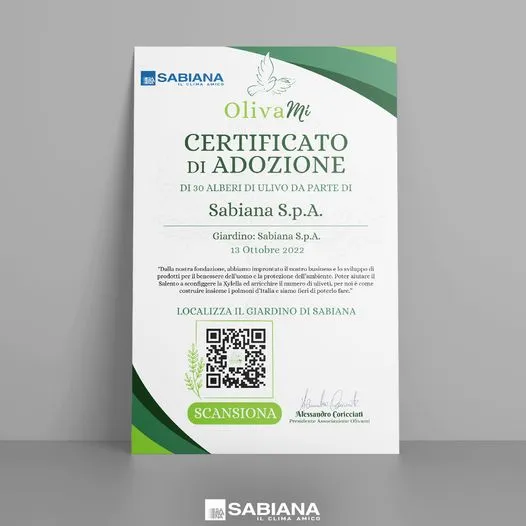
Sabiana's Garden: our social and sustainable contribution
Social responsibility takes many forms, sometimes even that of an olive grove! In fact, we have adopted 30 olive trees in Salento which absorb 18,000kg/year of CO2. Replanting new trees also helps the territory in the battle to reclaim Xylella: a choice we are proud of and which helps us build Italy's "lungs" together.
RCI talks about us.
RCI, the most authoritative Italian magazine in the sector of heating, air conditioning systems, hydronics and renewable energy, has published an article on “The biodiversity garden”, describing the extension of the Botanical Garden of the University of Padua, which Sabiana has contributed to. RCI, the most authoritative
Italian magazine in the sector of heating, air conditioning systems, hydronics
and renewable energy, has published an article on “The biodiversity garden”,
describing the extension of the Botanical Garden of the University of Padua,
which Sabiana has contributed to.
San Raffaele, Italian excellence
Gene therapy against the HIV virus works. The research findings were published in the prestigious San Raffaele magazine of Milan, and stemmed from the work of scientists at Istituto San Raffaele of Milan. A further acknowledgement for the Milanese structure which is confirmed as one of the most significant worldwide concerns in the field of research. San Raffaele uses Sabiana air handling units, to further prove the fact that leadership attracts leadership.Gene therapy against the HIV
virus works. The research findings were published in the prestigious San
Raffaele magazine of Milan, and stemmed from the work of scientists at Istituto
San Raffaele of Milan. A further acknowledgement for the Milanese structure
which is confirmed as one of the most significant worldwide concerns in the
field of research. San Raffaele uses Sabiana air handling units, to further
prove the fact that leadership attracts leadership.
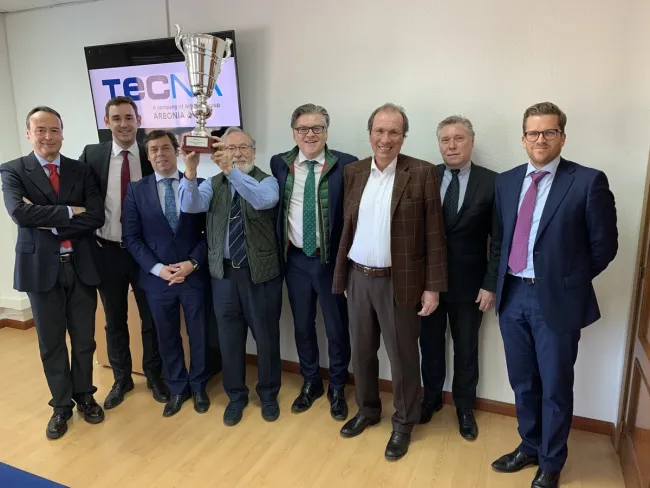
TECNA SL WINNER OF THE HVAC DIVISION "EXCELLENCE IN PROFITABILITY 2019" AWARD
This year the prestigious award of "Excellence in Profitability 2019" has been accredited to Tecn SL. The award ceremony took place in Madrid, Spain, on February 26th. Congratulations to all colleagues!
Sabiana air-conditions the New Egyptian Museum of Turin!
Yesterday the press was offered a preview of the new layout, stemming from 5 years of design and construction work and an investment of 50 million Euro.
The outcome is considered to be outstanding by all the world’s leading experts. The collection of finds is spread on an overall surface of 10,000 square metres, up from the previous 6,400, over four floors, connected by an escalator system that mimics an ideal journey upstream the Nile, designed by scenographer Dante Ferretti.
A chronological museum itinerary that covers a time span from 4000 b.C. to 700 b.C.
Visitors have the option of following each find on tablet and smartphone; a redesigned logo, a sort of graffiti with the hieroglyph symbolising water, hinting to a connection between the two rivers, the Nile and the Po; the addition of audio-guides in Arabic.
A true cultural jewel, which is already expected to attract long queues of visitors from all over the world. The second museum by importance on the planet, after the one in Cairo.
Carisma CRC and CRS fan coils by Sabiana have been selected for the air conditioning.
Yesterday the press was
offered a preview of the new layout, stemming from 5 years of design and
construction work and an investment of 50 million Euro.
The outcome is considered to be outstanding by all the world’s leading experts.
The collection of finds is spread on an overall surface of 10,000 square
metres, up from the previous 6,400, over four floors, connected by an escalator
system that mimics an ideal journey upstream the Nile, designed by scenographer
Dante Ferretti.
A chronological museum itinerary that covers a time span from 4000 b.C. to 700
b.C.
Visitors have the option of following each find on tablet and smartphone; a
redesigned logo, a sort of graffiti with the hieroglyph symbolising water,
hinting to a connection between the two rivers, the Nile and the Po; the
addition of audio-guides in Arabic.
A true cultural jewel, which is already expected to attract long queues of
visitors from all over the world. The second museum by importance on the
planet, after the one in Cairo.
Carisma CRC and CRS fan coils by Sabiana have been selected for the air
conditioning.